
Add companies or upload portfolios
Screen a single company or upload lists of counterparties to screen at scale. Business Radar supports company names, corporate identifiers and DUNS numbers for accurate entity recognition.


Business Radar screens companies and individuals against sanctions lists, PEP data and enforcement records, using our own directly maintained compliance database. Every match is verified, explained and traceable to its source.
We'll run the demo on entities you actually screen. Real results, not sample data. In 30 minutes you'll see how Business Radar resolves matches your current screening gets wrong or misses.
✓ Sanctions, PEP and enforcement data from our own compliance database
✓ AI-reviewed matches with visible reasoning, up to 90% fewer false positives
✓ Trusted by Rabobank, Atradius and Deloitte
Screen companies and individuals during onboarding and continue monitoring them over time. Business Radar continuously tracks new entries, updates and developments across sanctions, enforcement and global media sources, so changes in risk exposure are captured as they occur.
Sanctions and enforcement lists are updated continuously. Business Radar maintains its own compliance database, so list changes reach your screenings the same day, not after a vendor refresh cycle.
Simple name matching floods analysts with false hits on similar names, transliterations and common surnames. Every wrong match costs review time; every missed match is exposure.
A clean counterparty can be owned or controlled by a sanctioned party. Screening that stops at the legal entity misses the exposure underneath.
It is not enough to have screened. You need to show how a match was assessed and resolved, with a documented trail for every decision.
Screen companies and individuals Run checks on both companies and standalone individuals across sanctions lists, PEP data, enforcement records and adverse media.
Expand beyond a single entity Screening connects to broader corporate networks, so subsidiaries, parent companies and ultimate owners are covered, not just the name you enter.
Accurate, verified and explained Matches are validated and enriched with entity data. AI-assigned false positives come with visible reasoning and can be overridden, with every decision logged.
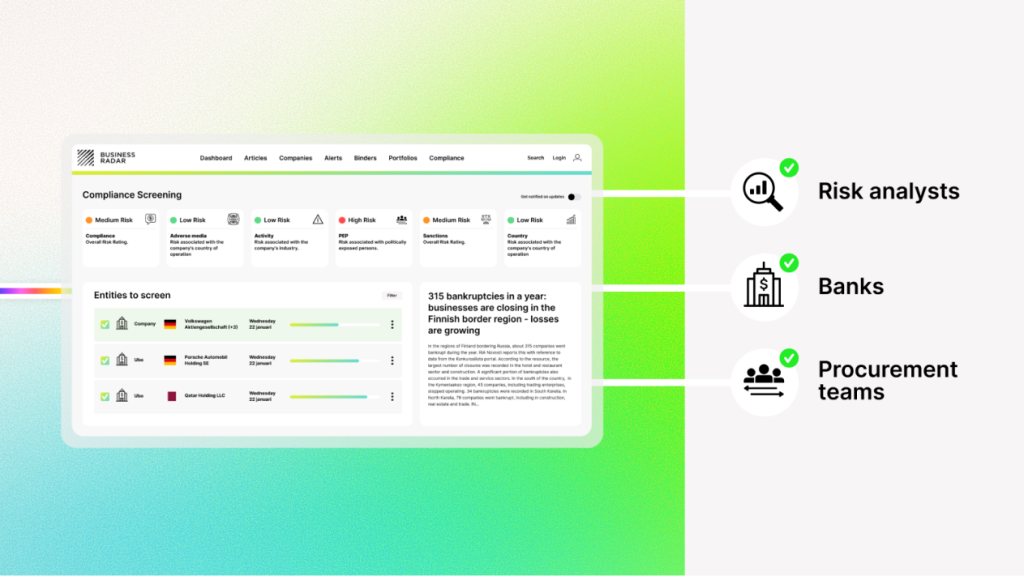
Companies and individuals are matched using trade names, identifiers and contextual data to reduce incorrect matches.
Sanctions, PEP and government-linked entity data comes from our own compliance database, updated as list changes occur rather than on a vendor refresh cycle.
Signals are reviewed and enriched before reaching analysts, reducing noise and improving result quality.
Results are enriched with company data, including directors, beneficial owners and corporate structures, so findings can be assessed without additional research.
The audit trail includes risk scores per category, a screening breakdown per entity, AI review notes with confidence levels, and reviewer notes and decisions.
Business Radar identifies risk signals linked not only to individual companies but also to their broader corporate networks. By combining corporate identifiers, trade names and company relationships, signals can be linked to subsidiaries, parent companies and global ultimate entities.
Adverse media monitoring often produces large volumes of irrelevant results. Business Radar applies contextual analysis and AI-assisted verification layers to confirm that articles genuinely refer to the relevant company.
Screen and review in the platform, or integrate via API with webhooks for real-time notifications, a company match endpoint and a Python SDK. Native integrations with HubSpot and Salesforce.
You define what is screened, monitored and reviewed. Exclude sanction lists outside your scope, set stricter matching rules for persons, and keep AI-rated false positives out of review queues.
Over 90 percent of our users with continuous monitoring enabled have reported that Business Radar identified high-risk signals in the past 12 months, which would have otherwise gone unnoticed.
Auditors using Business Radar have reported a 32 percent average increase in efficiency during periodic reviews and screenings, compared to traditional software.
A clean counterparty can still carry sanctioned exposure through its owners. Business Radar identifies beneficial owners and includes them directly in your screening, with ownership percentage, direct or indirect ownership, nationality and date of birth per UBO, so control structures are covered, not just the primary legal entity.








Risk Categories
Reduction False Positives
Global Company Records
Translated Languages
global sources
Business Radar screens companies and individuals across sanctions lists, PEP data, enforcement records and adverse media in one check. Screening runs at onboarding and continues afterwards: new entries, updates and developments are captured as they occur, so a change in risk exposure doesn't wait for your next periodic review.
Business Radar maintains its own compliance database and monitors sanctions and enforcement lists directly. If a monitored entity is added, removed or updated on a list, the alert reaches you the same day. There is no waiting for a third-party vendor refresh cycle.
Entities are matched using trade names, aliases, identifiers and contextual data. For PEP hits you can require a full last name match, and AI-reviewed matches include visible reasoning so your analysts can verify every decision.
Yes. Upload a list of counterparties and screen at scale against 135M+ global company records. Business Radar supports company names and corporate identifiers for accurate entity recognition, and screened entities stay under monitoring afterwards so new developments are captured automatically.
Every result is traceable: source data, entity context, corporate relationships and audit logs showing how matches were assessed. Findings are enriched with company context by default, so most results can be assessed without additional research, and the full trail supports internal audit and regulatory review.
Traditional providers maintain a curated database of profiles, which means you only see risks once an analyst has written them up. Business Radar combines list screening with live media monitoring, so signals surface as they happen rather than after they've been catalogued. And because we screen unstructured sources directly, coverage extends to unlisted and smaller companies that rarely make it into curated databases.
Yes. You define what is screened and monitored: which sanction lists are in scope, how strictly persons are matched, and whether AI-rated false positives appear in review. Settings apply organisation-wide, so every analyst screens to the same standard and review queues stay focused on genuine hits.